2 hours ago
Elliot Tuttle's Provocative Debut "Blue Film" Challenges Audiences with Unflinching Exploration of Trauma and Power
READ TIME: 5 MIN.
Elliot Tuttle has announced himself as a filmmaker unafraid to tackle provocative material with his feature debut "Blue Film," which premiered in competition at the 2025 Edinburgh International Film Festival. The film represents a significant achievement for independent cinema, particularly within LGBTQ+ storytelling, as it refuses the safety of conventional narratives in favor of a stark, unflinching examination of trauma, desire, and moral complexity.
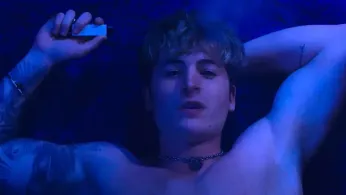
"Blue Film" tells the story of an intense, shocking encounter between Aaron Eagle, a camboy portrayed by Kieron Moore, and Hank Grant, a mysterious stranger played by Reed Birney, who arrives at an Airbnb rental in Los Angeles. What begins as a transactional meeting spirals into something far more unsettling as the night progresses, with the narrative exposing a buried connection between the two men that forces them to confront the wreckage of a past they believed they had left behind.
The film's central premise is deliberately provocative. The story explores a reunion between a former student and a former teacher accused of abuse, a subject matter that Tuttle acknowledged would present significant casting challenges. Yet rather than shying away from these complexities, Tuttle has crafted what critics describe as a hypnotic and disturbing yet strangely moving examination of power dynamics, desire, and the ways trauma shapes identity.
Tuttle's inspiration for "Blue Film" emerged from deeply personal reflections on his own sexual awakening. In the film's press notes, Tuttle explained: "I remember how badly I wanted my history teacher to want to have sex with me. And then I began to extrapolate who the character that I was fantasizing about might have actually been." This introspective starting point allowed Tuttle to explore themes of shame, self-loathing, and the narratives people construct to survive emotional pain.
The filmmaker has described his approach to the material as one rooted in unflinching honesty. While "Blue Film" is decidedly not an endorsement of the behavior it depicts, the film refuses to look away from it, presenting a stark, clear-eyed portrayal without judgment. This commitment to presenting the subject matter without excusing or glorifying it asks audiences to listen and form their own judgments—a deliberately challenging proposition in contemporary cinema.
Tuttle wrote the script during what he describes as a "quarter-life crisis," wrestling with grief and feeling disconnected from a more innocent version of himself. This personal turmoil infuses the narrative with authenticity; even as the story between Aaron and Hank grows darker, the film remains fundamentally about the baggage people carry when they are unable to forgive themselves for things they still feel guilty about.
The decision to contain the entire narrative within one Airbnb rental was both a creative and practical choice. Tuttle explained that he "wanted it to be very producible" while also embracing the conceptual framework of creating "an echo chamber of perversion, like there being no escape, except for maybe the humor that these two characters might bring in." The confined setting forces viewers to remain present with the characters for 90 minutes, unable to leave the space just as the characters themselves cannot escape their confrontation.
This constraint proved creatively liberating rather than restrictive. Tuttle notes that the shoot itself was "not tortured" as a process, and he shares fond memories of feeling creatively liberated while working at such a small scale with supportive collaborators. The entire production was completed in approximately two weeks, with the script written and cast assembled within just a few months.
The film's greatest strength lies in the performances of its two leads. Kieron Moore, in particular, delivers what multiple sources describe as a star-making turn. Moore was required to deliver approximately 30 pages of monologues and dialogue in an accent not his own across the first 30 minutes of the film—all shot in a day and a half. Director Tuttle revealed that Moore demonstrated intense preparation and engagement with the material, having conducted extensive research including reading books on psychology relevant to the film's themes.
Moore's performance captures an extraordinary emotional journey. He arrives cocksure and gradually reveals himself to be an innocent child again, making the transformation appear seamless. His portrayal radiates confusion and curiosity, creating a heartbreaking turn that, according to critics, would warrant awards consideration with appropriate distribution.
Reed Birney, whose performance in "Mass" had impressed Tuttle at Sundance, became the filmmaker's first choice to play Hank despite the role's challenging nature. Tuttle describes Hank as "a vessel to navigate ideas about sex that I wanted to explore," allowing Birney to anchor the narrative's exploration of desire and power dynamics.
The cinematography by Ryan Jackson-Healy employs startlingly effective extreme close-ups that penetrate Moore's emotional armor, offering glimpses of a lost but not yet destroyed soul. These technical choices reinforce the film's commitment to psychological intensity and emotional authenticity.
Though Tuttle considers "Blue Film" fundamentally a drama, he deliberately wrote the script with thriller mechanics, employing both creative instinct and practical necessity. With a small budget, two characters, and a single location, maintaining audience engagement required sustained momentum. Tuttle explains: "My job is to keep the narrative engine of the movie going. Any kind of slip in momentum is a potential death for a viewer."
This approach has proven effective. The film's strengths emerge in its capturing of internal reckoning—the psychological and emotional confrontations that drive the narrative forward with the intensity of a thriller while maintaining the emotional depth of character-driven drama.
"Blue Film" had its world premiere in competition at the 2025 Edinburgh International Film Festival, where it generated significant critical attention. Notably, American festivals repeatedly passed on the film before Edinburgh's programming decision unlocked a wave of international interest. This reception demonstrates that despite an increasingly risk-averse industry in the United States, there remains an appetite for what Tuttle describes as "subversive kind of cinema" that addresses difficult subject matter with artistic integrity.
Throughout the filmmaking process, Tuttle received crucial support from actor and producer Mark Duplass, who serves as a consulting producer on the project. Tuttle brought Duplass the script early in the writing process, and Duplass has consistently been supportive of the filmmaker's vision. Tuttle considers Duplass "a bit of a mentor figure" and praises his "comprehensive and unwavering"support of young filmmakers.
"Blue Film" represents an important entry into contemporary LGBTQ+ cinema, particularly because it centers queer male desire and trauma without sanitizing or simplifying the psychological complexities involved. The film's protagonist is a sex worker, a representation that challenges mainstream cinema's typical erasure or stigmatization of sex work. Through Aaron's character, Tuttle explores vulnerability, shame, and the performance of identity—themes central to queer experience.
The film's unflinching approach to its subject matter signals a filmmaker committed to artistic integrity over commercial palatability. In an era where many independent films struggle to find distribution and festival acceptance, "Blue Film" demonstrates that audiences and festival programmers hunger for cinema that engages honestly with difficult human experiences.